The Story Behind Lakshmi Narasimha: From Fierce Protector to Divine Peace
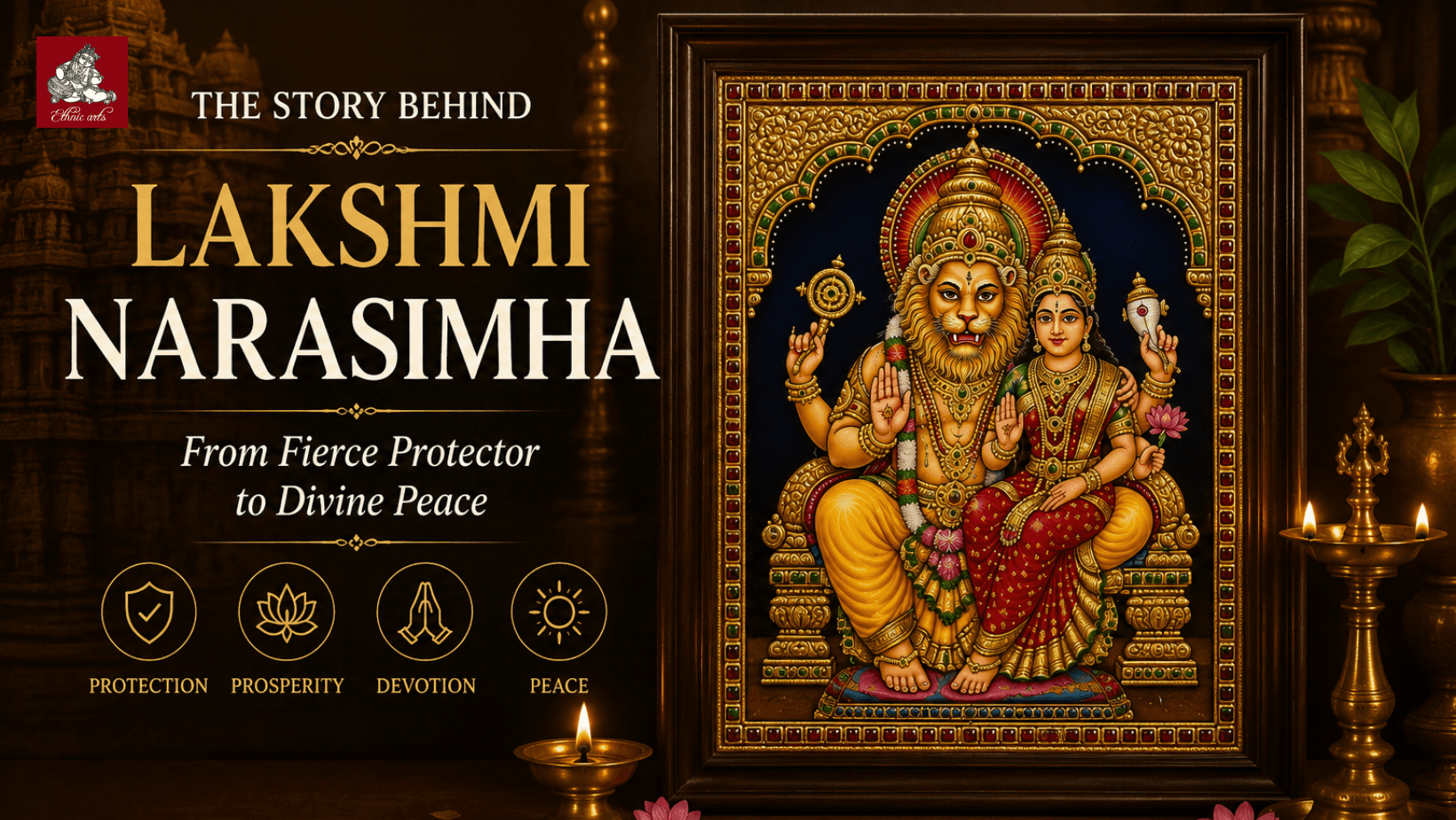
Among the many forms of Lord Vishnu, Lakshmi Narasimha carries a particularly powerful image: Lord Narasimha, with the face of a lion and the body of a man, seated peacefully with Goddess Lakshmi.
At first glance, the image seems to bring together two very different energies. Narasimha represents extraordinary strength and protection, while Lakshmi represents prosperity, grace and abundance.
But why are they depicted together?
The answer begins with one of the most celebrated stories of devotion in Hindu tradition: the story of Prahlada and Hiranyakashipu.
Who Is Lord Narasimha?
Lord Narasimha is traditionally regarded as the fourth avatar of Lord Vishnu. His name comes from Nara, meaning man, and Simha, meaning lion.
Unlike Vishnu's completely human or animal manifestations, Narasimha appeared in a form that was neither entirely human nor entirely animal.
This unusual appearance was not accidental. It was connected directly to a boon received by the powerful asura king Hiranyakashipu.
The Boon of Hiranyakashipu
According to the traditional account, Hiranyakashipu performed severe penance and received extraordinary protection from Lord Brahma.
His boon was designed to make his death seemingly impossible.
He could not be killed by a human or an animal, during the day or night, indoors or outdoors, on the ground or in the sky, or by an ordinary weapon.
With such protection, Hiranyakashipu became increasingly powerful and demanded that others recognise him as supreme.
But there was one person he could not convince: his own son, Prahlada.
Prahlada's Unshaken Devotion
Prahlada remained deeply devoted to Lord Vishnu despite his father's opposition.
Hiranyakashipu repeatedly tried to break his son's faith. Yet Prahlada continued to believe that Vishnu was present everywhere.
Eventually, Hiranyakashipu challenged him.
If Vishnu truly existed everywhere, was he present even inside a pillar?
Prahlada maintained that he was.
In anger, Hiranyakashipu struck the pillar.
And from it emerged Lord Narasimha.
Why Did Vishnu Take the Narasimha Form?
The form of Narasimha answered every condition of Hiranyakashipu's boon.
Narasimha was neither man nor animal, but both.
He confronted Hiranyakashipu at twilight, which was neither fully day nor night.
The encounter took place at a threshold, neither completely inside nor outside.
Narasimha placed Hiranyakashipu upon his lap, neither on the earth nor in the sky.
And he defeated him using his claws rather than a conventional weapon.
The story therefore represents more than the defeat of a powerful ruler. It shows that no amount of cleverness or worldly power can place injustice beyond the reach of dharma.
Most importantly, Narasimha appeared to protect Prahlada, whose devotion remained unwavering even when his life was threatened.
From Ugra Narasimha to a Peaceful Form
The story does not simply end with Hiranyakashipu's defeat.
Narasimha is initially represented in an ugra, or fierce, form. His divine anger embodies the force required to protect his devotee and destroy injustice.
Different Hindu textual and regional traditions describe the calming of Narasimha somewhat differently. The Bhagavata Purana, for example, gives an important role to Prahlada's prayers in pacifying him.
Other traditions connect Goddess Lakshmi with Narasimha's transition into a gentler and more peaceful form.
This brings us to Lakshmi Narasimha.
Who Is Lakshmi Narasimha?
Lakshmi Narasimha is an iconographic form in which Goddess Lakshmi is shown seated with Lord Narasimha, commonly upon his lap.
Here, the terrifying energy associated with the destruction of Hiranyakashipu has transformed.
Narasimha remains powerful, but his power is controlled and protective.
Lakshmi brings an expression of grace, prosperity and tranquillity to the composition.
Together, they create an image where strength exists alongside compassion.
That contrast is one of the reasons Lakshmi Narasimha has such a distinctive presence in Hindu sacred art.
What Does Lakshmi Narasimha Symbolise?
The Lakshmi Narasimha form can be understood through several interconnected ideas.
Protection
The story of Narasimha is fundamentally about protecting a devotee. Prahlada possessed neither political power nor physical strength capable of defeating his father. His strength was his devotion.
Narasimha therefore became an enduring symbol of divine protection and courage in the face of adversity.
The Victory of Dharma
Hiranyakashipu believed his boon placed him beyond defeat.
Yet every condition he depended upon was overcome without being directly violated.
The story serves as a reminder that power without righteousness is ultimately unstable.
Strength With Compassion
Narasimha's fierce form demonstrates the power necessary to confront injustice.
Lakshmi Narasimha presents what comes afterward: strength returning to peace.
This makes the image especially meaningful. Divine power is not shown as uncontrolled aggression, but as a force exercised for protection and restored to harmony when its purpose has been fulfilled.
Prosperity and Well-Being
Goddess Lakshmi is traditionally associated with prosperity, auspiciousness and abundance.
Her presence beside Narasimha creates a form in which protection and prosperity coexist.
Lakshmi Narasimha in Traditional Art
Lakshmi Narasimha has been represented through temple sculpture, bronze icons and traditional paintings across different parts of India.
The composition itself communicates much of the story without words.
Narasimha's lion face reminds the viewer of his extraordinary manifestation. His powerful form represents protection, while Lakshmi's presence changes the emotional character of the scene.
For an artist, capturing that balance is particularly important.
Make Narasimha too fierce and the serenity of Lakshmi Narasimha disappears. Make him too gentle and the protective power behind the story can be lost.
The beauty lies somewhere between the two.
Lakshmi Narasimha in Tanjore Paintings
This balance makes Lakshmi Narasimha particularly suited to the visual language of traditional Tanjore painting.
Tanjore art is known for its rich ornamentation, raised decorative work, intricate detailing and extensive use of gold foil.
When Lakshmi Narasimha is portrayed in this tradition, the gold and ornamentation do more than make the artwork visually striking. They help emphasise the divine presence at the centre of the composition.
The calm presence of Lakshmi, the powerful form of Narasimha and the richness associated with traditional Tanjore craftsmanship come together to create an artwork with both visual and spiritual significance.
Why Lakshmi Narasimha Continues to Be Worshipped
The story behind Lakshmi Narasimha remains relevant because it deals with ideas that extend far beyond its ancient setting.
Power can create fear.
Faith can survive adversity.
Protection sometimes requires strength.
But strength does not have to remain anger forever.
Lakshmi Narasimha brings these ideas together in a single divine form: fierce enough to protect, yet peaceful enough to bless.
Bringing the Story of Lakshmi Narasimha Into Your Home
A traditional Lakshmi Narasimha painting is more than a depiction of two deities. Behind the image lies the story of Prahlada's devotion, Narasimha's protection, the triumph of dharma and the eventual return from fierce energy to peace.
At Ethnic Tanjore Arts, traditional Tanjore paintings celebrate these stories through detailed craftsmanship and the distinctive beauty of this centuries-old South Indian art form.
Explore Lakshmi Narasimha and other traditional Tanjore paintings at Ethnic Tanjore Arts and bring home an artwork rooted in devotion, heritage and craftsmanship.
